



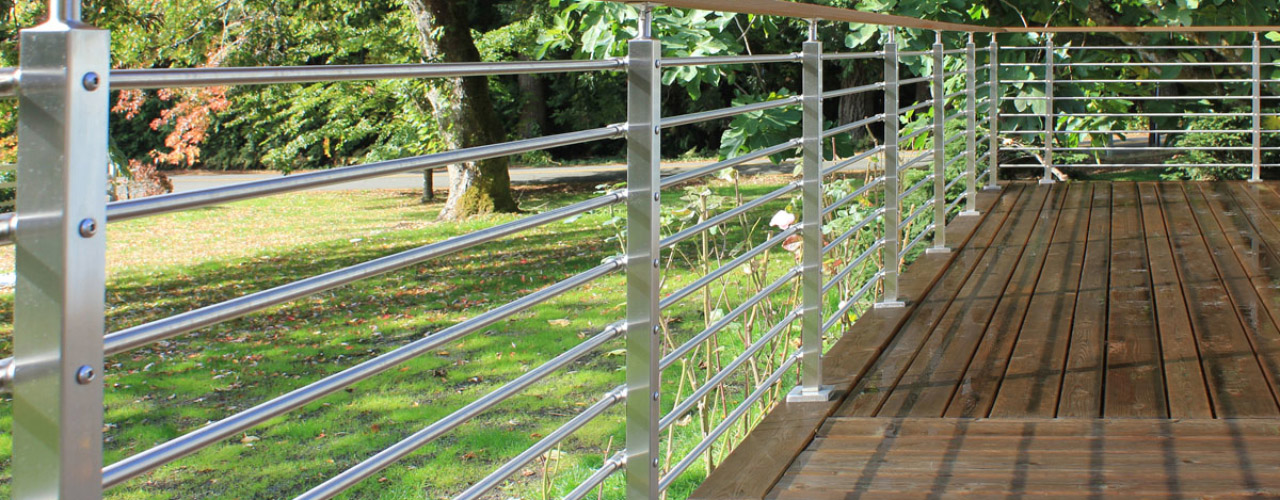

Ensuring Your Railing Meets Code
Comprehensive resources to help you ensure that your railing meets code, passes inspections and keeps people safe. Before you buy materials, consult your local building code office to identify specific local amendments that may be stricter than national IBC or IRC standards.
Essential Code Definitions
- International Residential Codes (IRC)
The IRC applies to one- and two-family dwellings. Most residential decks fall under IRC territory. - International Building Codes (IBC)
The IBC applies to all other structures, including commercial, institutional, and high-rise apartments. - Americans with Disabilities Act of 1990 (ADA)
The ADA is a federal civil rights law that applies to public accommodations and commercial spaces. Its standards do not apply to private homes.
Have questions? Our AGS experts can help you with understanding code requirements or any other concerns you might have about planning for your railing project.
Finding Your Local Codes
State & National: Use UpCodes.com or the ICC to view the base “I-Codes” adopted by your state.
- Local Amendments: Check eCode360 or Google your “[City] Municipal Code.” Local laws are the final word.
- Ask the Expert: Call your local Building Permits Department. Ask: “Which year of the IRC/IBC is adopted, and is there a ladder effect rule?”
Step-by-Step Compliance Guide
Use these five core requirements to assess if your residential railing is safe, secure, and ready for inspection.
- Check Railing Height Requirements. For surfaces >30″ above ground, a 36″ minimum guardrail is required. Stair handrails must be between 34″ and 38″ high.
- Use the “4-Inch Sphere” Rule. Check spacing between infill (cables/rods). The space between must prevent a 4″ sphere from passing through. On stairs, the “triangle” allows a 6″ sphere.
- Check Structural Load Standards. The top rail must withstand a 200lb concentrated load in any direction. Infill must withstand a 50lb load per square foot.
- Note Specific Requirements for Cable. Because cable is flexible, a system should have intermediate posts every 3 feet to prevent deflection. Cables should be tensioned enough that they do not deflect when pushed. Always check local “ladder effect” rules for horizontal infill.
- Ensure “Grabability” of Handrails. Handrails must be graspable. Type I (Circular) rails must be 1.25″–2″ in diameter for graspability. Type II (Large) rails require a finger recess so that they can be gripped securely.