
Frequently Asked Questions
Everything you need to know about our materials, engineering, and getting your project started.
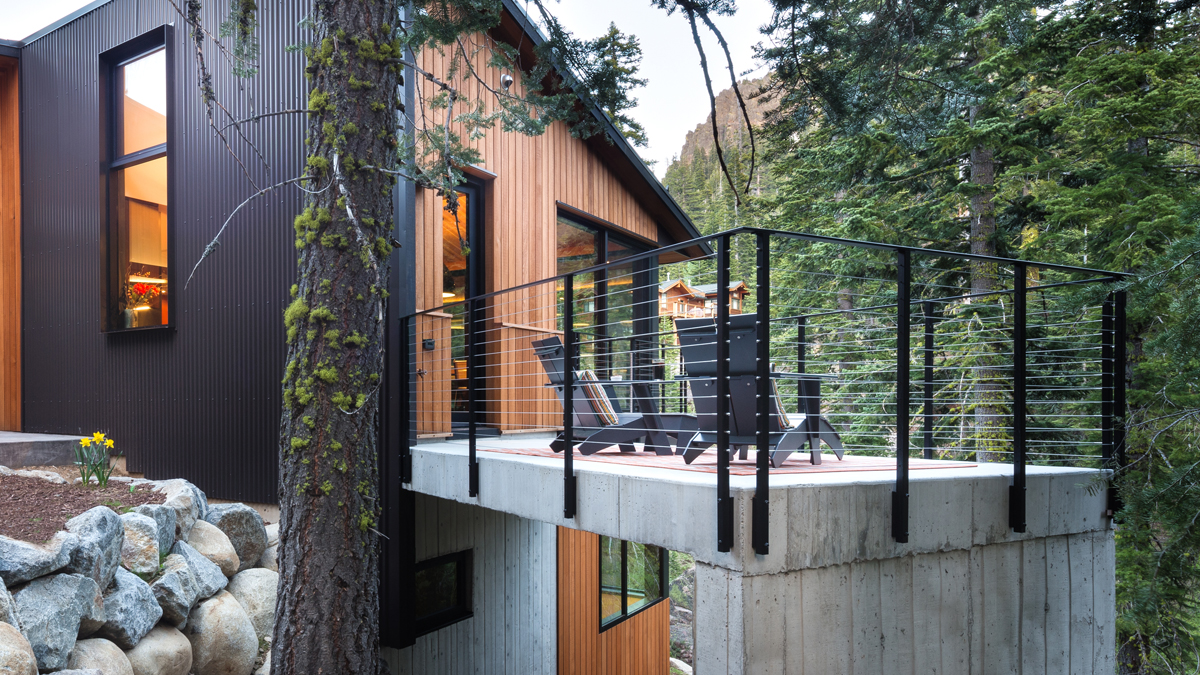
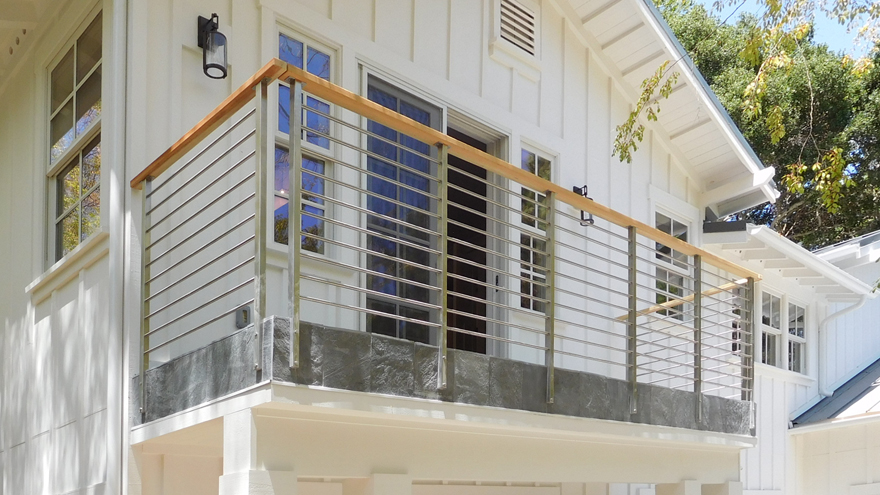
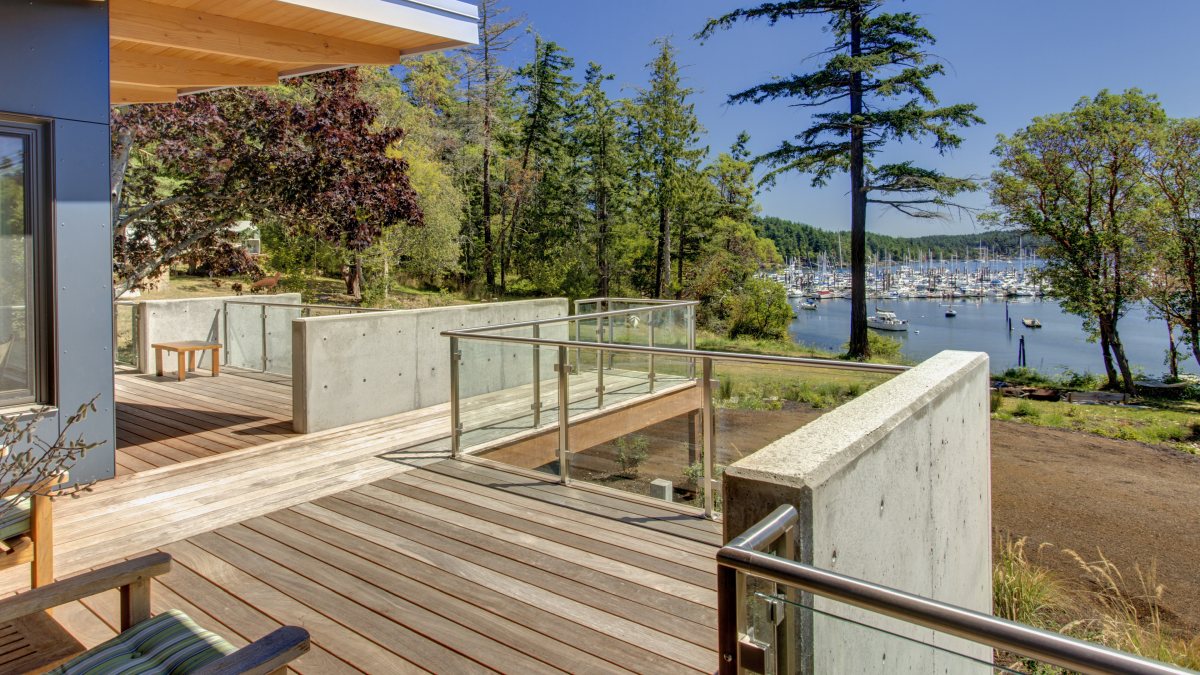
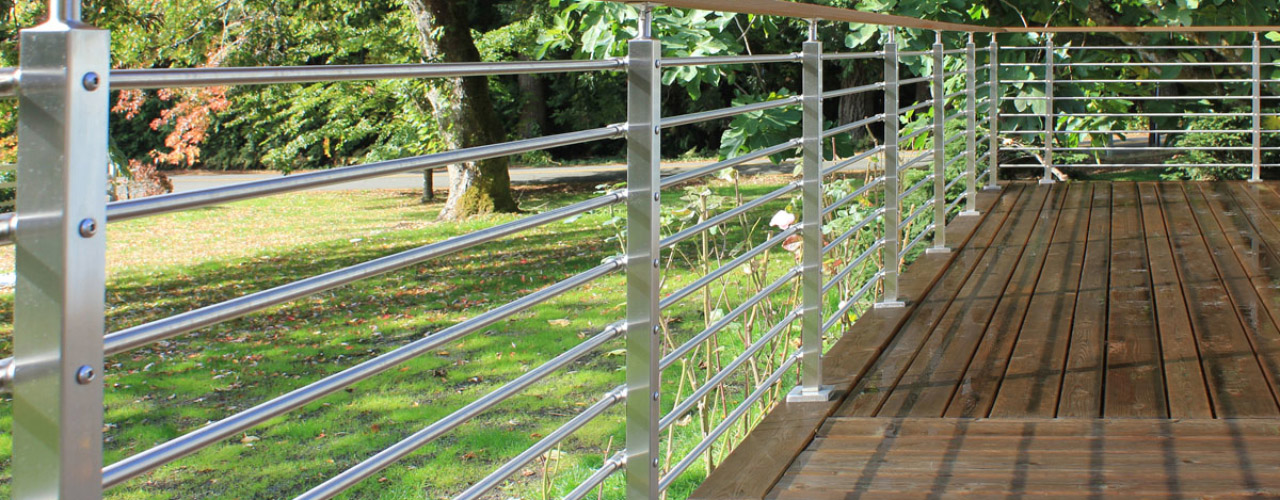
Four custom-fabricated systems, all 316 marine-grade stainless: Rainier Cable, Olympus Rod, Glacier Glass Panel, and Cascadia Kit — built to your exact dimensions and shipped ready to install.
Compare options on our Select Railing guide, or request a free estimate.
It comes down to infill: Rainier has 1/8” diameter cables, oriented horizontally or vertically, Olympus uses 5/8” diameter bars, oriented horizontally or vertically, and Glacier has clamps that will accept any panel, most commonly glass. Cascadia is our ‘off-the shelf’ kit system with horizontal bars.
Posts are, typically, 1 ½” square tubing, smaller than most railing systems, allowing for a wider view. In rare cases, we utilize 1 ½” x 3” tubing.
We have round (1 5/8” diameter) and flat (1/2” x 2”) sections available. Several types of wood sections (1” x 2”) are available in 8’ lengths. For further design flexibility, our posts will work with any flat-bottom section, including deck boards.
Brushed finished tubing provides that classic stainless steel look. Powder coating is also available, with color-match capability.
Our components are 316 marine-grade stainless. Its chemical composition makes it highly resistant to the pitting and corrosion caused by salty and other harsh environments. Our cable is electropolished, which is an effective treatment that adds further corrosion-resistance to the crevices formed by the wound strands.
More on the metallurgy: Material and Benefits.
Yes. Stainless steel is 100% recyclable and built to last decades, so it avoids the landfill cycle of wood or composite railing. Prefabrication also minimizes on-site waste.
More on Sustainability and LEED Information.
Cable is 1×19 1/8” diameter for most projects (3/16-inch available for a heavier commercial look). The 1×19 construction resists stretching and sagging, resulting in less maintenance.
Typically, cables are tensioned with a nut on a threaded fitting for a clean line without mid-span hardware. Tensioning is simple with common hand tools.
Watch it in action: How to Install Cable Railing.
Because we do not provide the glass panels, we recommend discussing that with your glass vendor. They should be able to verify what your jurisdiction requires.
Of course! Every railing system (except Cascadia) is designed to meet your project’s measurements. Beyond that, you can choose from features such as base plate covers, stem reducers, or lighting, to really make the system your own.
Standard heights are 36” and 42”, covering most code requirements — but we can custom-fabricate for your project needs.
See Ensuring Code Compliance for your specifics.
Up to 4 feet for residential projects, 3 feet, typically, for commercial.
Unusual runs or angles? See Build Complex Systems.
Both are engineered to meet the same load requirements — codes don’t differentiate. Factors to be considered when choosing mounting type include, supporting structure allowances, waterproofing, and deck space. And, of course, aesthetic.
Yes. Top rail lighting, post lighting and our StarLight solar-powered LED lights are common upgrades.
See Accent Lighting or browse the online store.
Pricing depends on your layout, system, infill, and mounting choices — every system is custom-fabricated. Send a simple drawing with approximate dimensions and we’ll typically return an itemized estimate within 1-2 business days, free and with no obligation.
Yes, we offer financing through A US Bank partner, Avvance.
Details on Flexible Financing, or contact us with questions.
We accept major credit cards, checks/ACH, and wire transfers.
Yes. Systems are engineered to current IRC (residential) or IBC (commercial) requirements. Calculations are available for submission to building departments for local compliance.
More on Ensuring Code Compliance.
Typically, 36” or 42” for residential applications, and 42” for commercial. Stair handrails run 34”-38” above the nosing. Note that these are guard heights. If the railing is sitting atop a curb or pony wall, it may be shorter.
‘Safe’ is a subjective term, which is why we have building codes — and our railing systems meet the requirements of the latest editions of the IRC/IBC.
This question is probably an indirect reference to the ‘ladder effect’, or climbabilty, of horizontal infill members. There was a provision outlawing this in the 2000 version of the governing codes, but it was removed the following year.
Yes, when applicable, we design to ADA standards for handrail height, graspability, continuity, and extensions.
Details: ADA Compliance.
Just send us a drawing (even a rough sketch or photo works) with approximate dimensions and a few project details such as height, top rail, infill, and mounting method. We’ll typically return an itemized estimate within 1-2 business days, free and with no obligation.
Use our Measure and Draw guide, then request your estimate.
Timelines vary with project size and complexity. Schedule is a topic that will be discussed.
UPS Ground is the default shipping choice. However, special arrangements can usually be accommodated.
Yes.
Our railing systems are designed and fabricated to be DIY install-friendly. Most components arrive ready-to-install; some require a little attention (flat top drilling for post attachment, cable cutting). Basic construction knowledge and common power tools are enough for a professional result.
See Installation.
If you are considering installing the system yourself, you probably have most of the tools you need, already. Cable cutters and crimpers are available through AGS and are required for correct installation.
Available in our online store.
Our Installation page covers the full process, and Installation Videos walks through specific tasks like tensioning cable and setting post heights. Curves or multi-level transitions?
For the original purchaser, AGS warrants products against defects in material and workmanship for ten years, covering repair or replacement. Claims must be filed within 30 days of discovering a defect, with photos and proof of purchase.
Full terms: Warranty.
To keep your railing looking new, periodic rinsing/washing is necessary. Frequency will depend on where you live and the environment. There are manly stainless steel-specific cleaning products available, but you can start with a chloride-free, mild soap and water solution.
Full routine and video: Maintain and Care.
If exposed to chlorides (salty air, pollution, etc.), and left untreated, even stainless steel will show some surface degradation, called tea-staining. Should you see tea-staining or heavier corrosion, we have products available to remove it and restore the original luster. That said, a preventative maintenance plan is the best policy to avoid it, altogether.
The science: Material and Benefits.
A guardrail (‘guard’ in the Code) is the full barrier preventing falls; a handrail is the graspable support on stairs, mounted 34”-38” above the nosing.
Just provide us with a simple sketch, maybe a few photos, and we will send an easy-to-complete Dimension Request Form that shows you what we need to create your custom railing.
While supporting structure plays a big role in this decision, fascia mounting often wins for balconies: it maximizes walkable floor space and avoids penetrating a waterproof surface over living space below. However, we have many tools in our design kit that allow us to make either condition work in most instances.
Yes, we use short, straight segments and angles made in our shop to match CAD drawings to follow your deck’s contours. Additionally, depending on the layout, top rail can be curved.
Yes, with stainless wedge anchors (available through AGS) or epoxied rod, a hammer drill, and a concrete bit.
Step-by-step: Installation Videos.
Yes. The posts work with any flat-bottomed wood cap. A popular choice for cabins and craftsman homes, and the wood typically matches your project locally. We have some wood sections available for purchase.
Contact us to discuss your design.
Absolutely. Trade professionals are core to our business. We can work from field dimensions or CAD drawings, and fabricate precision systems with no field welding, meaning faster installs for your crew.
See our Professional Resource Center, or send us your drawings.
Yes, our Specs and Drawings library covers every standard railing system. CAD drawings are produced for each project, and stamped engineering calculations are available, as well.
AGS is listed in MasterSpec and maintains a library on CADdetails and BIMobject. We’re also a NOMMA member and active in AIA and NAHB programs.
The program connects you with our team, deepens your familiarity with our systems and installation practices, and positions your company as a go-to installer for premium railing.
Details: Become an AGS-Certified Builder.
Typical project progression includes customer sign-offs on the Dimension Request and Final Approval Drawings. Depending on project complexity and requested changes, multiple iterations of drawings may be issued.
We are always looking to help our partners win and do well on projects. Price is often a key component in this. Give us a call so we can discuss.
Contact us or call 1-888-842-9492 to discuss.
Request an estimate
Fill out the form below to get an estimate for your project. To get the most accurate estimate, please attach sketches or photos of the area where you’d like to install a railing.
For more about measuring and drawing, click here. To download our printable sketch sheet, click here.
Our Awards







Find Us In:




Request an estimate
Fill out the form below to get an estimate for your project. To get the most accurate estimate, please attach sketches or photos of the area where you’d like to install a railing.
For more about measuring and drawing, click here. To download our printable sketch sheet, click here.
Our Awards
Find Us In: